Why Newly Incorporated UK Companies Make Accounting's Best New Clients
When a new company is incorporated at Companies House, the director immediately faces a checklist of financial obligations - registering for Corporation Tax, opening a business bank account, understanding VAT thresholds, setting up bookkeeping. Most have no existing accountant.
This creates a narrow window - typically the first 90 days after incorporation - during which newly incorporated companies are actively searching for an accountant and have not yet committed to one. After that window closes, most stick with whoever they chose first.
How many new companies register in the UK each year?
Approximately 500,000 to 700,000 new companies are incorporated in the UK each year - around 1,500 per working day. Not all need a full accounting service immediately (dormant companies and holding entities make up a portion), but a large share of active trading companies are looking for professional support within their first quarter.
Which SIC codes produce the most accounting enquiries?
Certain industry categories consistently generate companies that need active accounting support from early in their trading life:
- Construction and trades (SIC 41-43) - CIS compliance requirements, materials purchases, and sub-contractor payroll create an immediate need for professional bookkeeping.
- Professional services (SIC 69-74) - consultancies, agencies, and professional practices typically need accounting from the outset for invoicing, expenses, and IR35 assessment.
- Retail and e-commerce (SIC 47) - VAT registration decisions and stock accounting create early complexity.
- Technology and software (SIC 62-63) - R&D tax credit eligibility means early accounting advice has material financial value for founders.
- Hospitality and food (SIC 55-56) - cash handling, staff payroll, and VAT requirements apply from trading day one.
What new companies actually need in the first 90 days
Understanding what new companies need - and when - shapes what a practice offers on first contact:
- Weeks 1-4: Corporation Tax registration (mandatory within 3 months of starting to trade), business bank account setup, understanding of allowable expenses
- Weeks 4-12: Bookkeeping system setup, payroll registration if hiring, VAT registration decision
- Months 3-9: First VAT return (if registered), payroll runs, management accounts
- Months 12-21: First annual accounts, Corporation Tax return, confirmation statement
Accountants who make contact in weeks one to four can shape all of the above. Those who wait are competing for an established client who already has processes in place.
The timing advantage
The director of a company that incorporated three weeks ago is in a fundamentally different decision state than the director of a two-year-old business. The new company director:
- Has not filed a single return - they have not experienced a competing firm''s service
- Has no loyalty to an incumbent accountant
- Is actively problem-solving - they want answers, not a pitch
- Is likely to stay with their first accountant for years if the relationship starts well
Regional concentration of new incorporations
London consistently accounts for 30-35% of new UK incorporations. The South East, Midlands, and North West are the next-largest clusters. For practices with a geographic focus, these regional patterns determine which postcode areas to prioritise.
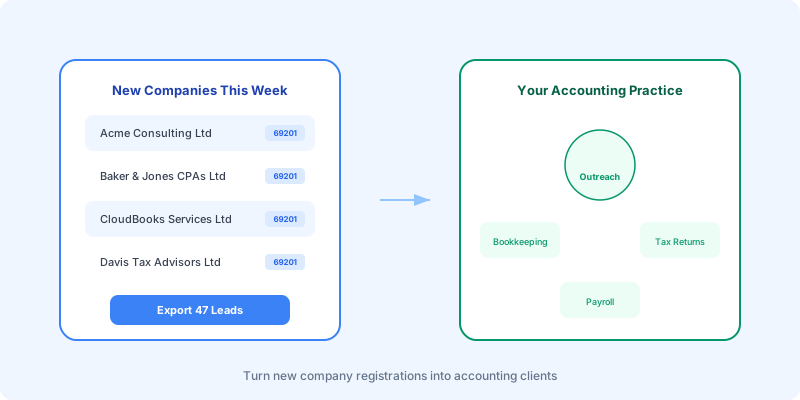
For accountancy firms looking to build a systematic pipeline from new company registrations, see how practices use NewcoHunter to monitor new incorporations by SIC code and postcode area.
About the author
Alexis Pratsides is founder of NewcoHunter and writes these guides from operating the data pipeline behind it. More about Alexis
Related Articles
When Do New UK Companies Start Spending on Marketing?
Most new UK companies do not have a marketing budget on day one - but they acquire one faster than most agencies realise. Understanding the timing changes how agencies approach new company outreach.
What Legal Services Do Newly Incorporated UK Companies Need?
From shareholders agreements to employment contracts, new company directors face significant legal requirements in their first year. Understanding what they need - and when - is the first step.
Finding New Business Leads from Companies House Data
How B2B sales teams, accountants and service providers can use Companies House new company data as a lead generation channel.
Ready to find your next client?
Get instant access to new UK company registrations, filtered by industry and location.
Get started free