Understanding Company Accounts on Companies House
Every UK company must file accounts at Companies House, but the level of detail varies enormously depending on the company's size. Understanding what's available - and what's missing - is key to effective company research.
Types of Company Accounts
Micro-Entity Accounts
The smallest companies (turnover under £632,000, balance sheet under £316,000, fewer than 10 employees) can file heavily abbreviated accounts containing just:
- A very basic balance sheet
- A few notes
There is no profit and loss account and no turnover figure. This makes financial analysis extremely limited.
Small Company Accounts
Small companies (turnover under £10.2 million, balance sheet under £5.1 million, fewer than 50 employees) can file abridged accounts. These include:
- Balance sheet with more detail than micro-entity accounts
- Notes to the accounts
- Still no P&L or turnover required at Companies House (though they must prepare full accounts for shareholders)
Medium Company Accounts
Medium companies can file slightly abbreviated accounts but must include a profit and loss account (though they can start from gross profit rather than showing turnover).
Full Accounts (Large Companies)
Large companies must file complete accounts including:
- Full balance sheet
- Profit and loss account with turnover
- Cash flow statement
- Directors' report
- Detailed notes
- Auditor's report
How to Read a Balance Sheet
Even from abbreviated accounts, the balance sheet reveals useful information:
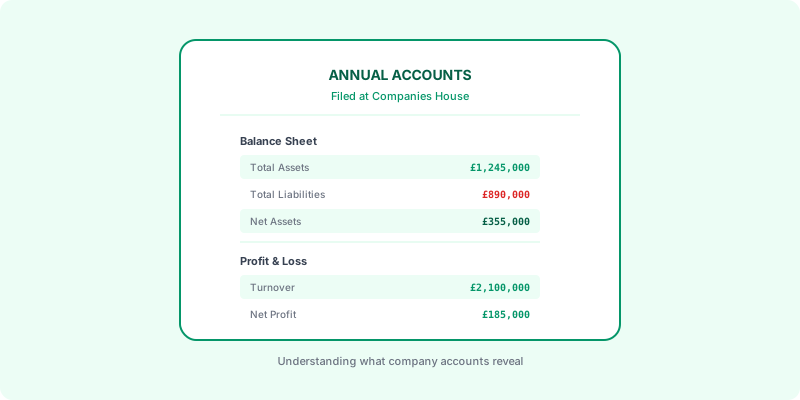
- Net assets: Total assets minus total liabilities. A negative figure means the company's liabilities exceed its assets - a warning sign
- Cash at bank: How much cash the company holds. Low cash relative to current liabilities suggests potential cashflow problems
- Creditors due within one year: Money owed in the short term. Compare this to current assets to assess liquidity
- Creditors due after one year: Long-term debt. High levels may indicate the company is heavily leveraged
- Share capital and reserves: Shows how the company has been funded and its accumulated profits or losses
Filing Deadlines
Companies must file accounts within:
- 9 months of the accounting reference date for private companies
- 6 months for public companies
Late filing incurs automatic penalties ranging from £150 (up to 1 month late) to £1,500 (more than 6 months late) for private companies, and double these amounts for public companies.
A company that consistently files late may be disorganised or in financial difficulty. Companies House marks overdue accounts on the company record.
What Accounts Don't Tell You
Even full accounts have limitations:
- They're historical: By the time accounts are filed, they can be up to 21 months old (12-month accounting period + 9-month filing deadline)
- They can be window-dressed: Companies can time transactions to improve the balance sheet at the reporting date
- No customer or supplier detail: You won't see who the company trades with
- Management accounts differ: The company's internal financial picture may look very different from the statutory accounts
Using Accounts in Research
When researching a company through NewcoHunter or Companies House:
- Check the filing history - are accounts filed on time?
- Compare year-on-year - is the balance sheet growing or shrinking?
- Look at the accounting reference date - has it been changed recently? (This can be used to delay filing)
- Check the auditor's report (if applicable) - any qualifications or going concern notes?
Related guides
- When are company accounts due?
- How to check a UK company's age
- Filing deadline calculator
- How to verify a UK company
Related: One of the most useful figures on the balance sheet is net assets - learn what it means, the formula, and how to read it.
About the author
Alexis Pratsides is founder of NewcoHunter and writes these guides from operating the data pipeline behind it. More about Alexis
Related Articles
What Are Net Assets? Formula and How to Read Them in Company Accounts
What net assets are, the formula, and how to read them in a company's accounts.
Negative Net Assets: What It Means for a Company
What negative net assets means, why it happens, and whether it signals insolvency.
How Company Registration Works at Companies House
A concise overview of the UK company registration process - what happens when a new company is formed, what data is filed, and how quickly it appears on the register.
Ready to find your next client?
Get instant access to new UK company registrations, filtered by industry and location.
Get started free