Complete Guide to UK Company Registries Including Crown Dependencies
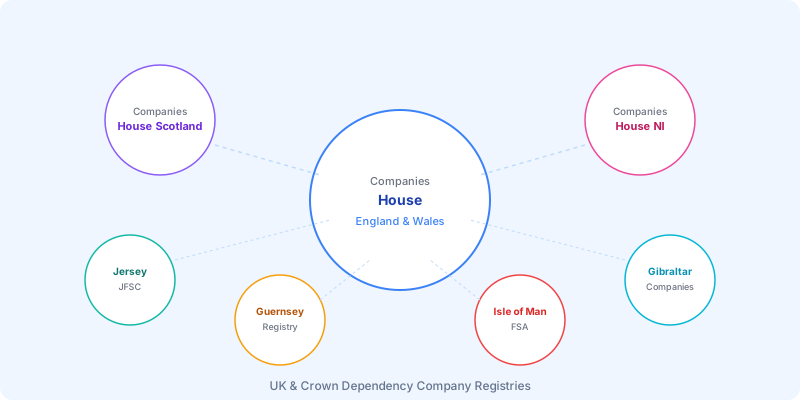
While Companies House is the best-known company registry in the UK, it is not the only one. The Crown Dependencies - Jersey, Guernsey, and the Isle of Man - each maintain their own registries with different rules and disclosure requirements. And just beyond the Crown Dependencies sits Gibraltar, a British Overseas Territory with its own company register. Understanding the full landscape is essential for thorough company research, whether you are an accountant onboarding a new client, an insurer assessing group structures, or a B2B sales team prospecting into a new market.
This guide covers each jurisdiction in turn, compares transparency levels, and explains what the differences mean in practice for due diligence and anti-money laundering (AML) checks.
Companies House (England, Wales, Scotland & Northern Ireland)
Companies House is the registrar of companies for the United Kingdom. It holds records for over 5 million active companies and is one of the most transparent company registries in the world. Incorporated companies, limited liability partnerships (LLPs), and some other entities are all on the public register. The register is maintained under the Companies Act 2006 and a series of subsequent reforms - including the Economic Crime (Transparency and Enforcement) Act 2022 - that have progressively increased disclosure obligations.
What's Available Free
- Company name, number, registered address, and incorporation date
- SIC codes (nature of business)
- Director and secretary details (names, dates of birth - month/year only, nationality)
- Persons of Significant Control (PSC) - beneficial ownership
- Filed accounts and annual returns/confirmation statements
- Charges (mortgages and security interests)
- Insolvency and winding-up information
The depth of the free data is genuinely unusual by international standards. Filed accounts for most companies include profit and loss statements, balance sheets, and notes - all publicly downloadable as XBRL or PDF at no cost. Smaller companies have reduced filing requirements, but the core identity, officer, and PSC data is always public.
It is worth noting that the UK's PSC register (Persons of Significant Control) is particularly significant for due diligence. Any individual who holds more than 25% of shares, voting rights, or the right to appoint or remove the majority of directors must be named. This makes beneficial ownership visible in a way that most offshore registries explicitly avoid. For a deeper look at how to work with this data, see our Companies House complete guide.
Searching Companies House
The free search at find-and-update.company-information.service.gov.uk (also known as Companies House Beta) gives access to all public records. The Companies House API allows programmatic access for up to 600 requests per 5 minutes. Bulk data downloads of the full register are also available for researchers and data providers who need the entire dataset rather than record-by-record lookups.
If you want to monitor Companies House for new registrations - for example to catch newly incorporated companies in a specific sector or region - tools like NewcoHunter automate that process, alerting you when companies matching your criteria are registered.
Jersey Financial Services Commission (JFSC)
Jersey, as a Crown Dependency, has its own company registry managed by the JFSC. Jersey is a major offshore financial centre with over 30,000 registered companies. Its legal system draws on a mixture of Norman customary law and English law, giving it a distinct company law framework from the UK.
Jersey companies are widely used for holding structures, funds, and trusts - particularly by international groups who want a stable, English-speaking jurisdiction outside the EU and outside UK tax law. This makes Jersey appearances in company structures common, and understanding what data you can and cannot access matters when you encounter one.
- Registry: JFSC Registry (registry.je)
- Free data: Company name, number, type, registration date, and registered agent name
- Paid data: Annual returns, memorandum and articles of association - document retrieval typically carries a fee per document
- Beneficial ownership: Jersey operates a central beneficial ownership register, but it is not publicly accessible. Access is restricted to law enforcement, regulatory authorities, and certain professional intermediaries with a legitimate purpose
- Key difference: Jersey companies must appoint a registered agent - a JFSC-regulated firm - rather than simply maintaining a registered office address. This means you can often identify the administering firm, but not the underlying principals
For AML purposes, professional intermediaries conducting Jersey due diligence need to use direct registry requests, information from the registered agent, or commercial data providers that have aggregated what is available. Free open-web searching will only get you so far.
Guernsey Registry
Guernsey (formally the Bailiwick of Guernsey, which also includes Alderney and Sark) maintains its own register of companies, limited partnerships, and foundations. Like Jersey, it is a self-governing Crown Dependency with a distinct legal framework rooted in Norman customary law.
Guernsey is particularly well known as a funds jurisdiction and is home to many investment fund structures, insurance vehicles, and holding companies. The island has worked to maintain its reputation as a well-regulated jurisdiction, particularly in the context of international AML and tax transparency standards.
- Registry: Guernsey Registry (guernseyregistry.com)
- Free data: Company name, number, type, status, and registration date
- Paid data: Copies of constitutional documents and filed returns are available on request, typically for a fee
- Beneficial ownership: Guernsey introduced a beneficial ownership register in 2017, but it is not publicly accessible - it is available to law enforcement and the tax authority via a central database held by the Guernsey Financial Investigation Unit
- Director data: Director information is not as openly searchable as in the UK; some details are available on request or through formal channels
Guernsey has committed to implementing public beneficial ownership registers in line with international standards, but as of the time of writing, public access remains restricted. Anyone conducting AML checks on a Guernsey-registered entity should not expect to be able to identify beneficial owners through the public register alone.
Isle of Man Companies Registry
The Isle of Man (IoM) is a self-governing Crown Dependency in the Irish Sea, distinct from both the UK and the other Channel Island dependencies. It has its own parliament (Tynwald) and a well-established financial services sector, including banking, insurance, and online gambling.
The Isle of Man Companies Registry operates under the Isle of Man Financial Services Authority (IoMFSA). Its company register is searchable online, but the depth of free information is more limited than Companies House.
- Registry: Isle of Man Companies Registry (services.gov.im)
- Free data: Company name, number, type, status, and date of incorporation
- Paid data: Annual returns, incorporation documents, and filed records are available but typically require a fee per document
- Beneficial ownership: The Isle of Man operates a central register of beneficial ownership, but - like Jersey and Guernsey - it is not publicly accessible and is available only to competent authorities
- Key difference: The IOM offers a unique 1931 Act company structure that some businesses still use for historical reasons, alongside the more modern 2006 Act companies. Encountering a 1931 Act company can signal an older or more complex structure
The Isle of Man has been on the OECD's list of jurisdictions committed to tax information exchange and has signed numerous Tax Information Exchange Agreements (TIEAs). Compliance posture is generally considered reasonable by international standards, but the lack of public beneficial ownership data remains a practical barrier for external researchers.
Gibraltar Companies House
Although not a Crown Dependency (it is a British Overseas Territory), Gibraltar has its own Companies House and is worth including in this overview because it appears frequently in certain business contexts - particularly online gambling, financial services, and crypto-adjacent ventures.
Gibraltar was an EU member territory before Brexit via the UK's membership. Post-Brexit, it lost EU passporting rights, but it has maintained close ties with the UK under a separate arrangement and retains a distinct regulatory environment.
- Registry: Gibraltar Companies House (companieshouse.gi)
- Free data: Company name, number, and status are searchable; the depth of free information is more limited than the UK register
- Paid data: Documents including incorporation records and filed returns are generally available on request for a fee
- Beneficial ownership: Gibraltar has introduced beneficial ownership requirements, but public access is restricted - the register is available to competent authorities rather than open to the public
- Key difference: Gibraltar companies are often used for online gambling and financial services due to its regulatory framework. Post-Brexit, Gibraltar's relationship with both the UK and EU remains in transition, which can affect how Gibraltar-incorporated entities interact with UK and EU markets
Comparing Transparency
The table below summarises the key differences in public data availability across the five registries. Note that rules can change as jurisdictions implement international AML and transparency commitments, so always verify current requirements directly with the relevant registry or a legal adviser.
| Registry | Beneficial Ownership | Free Accounts / Filed Docs | Free Director Data | API Access | Overall Transparency |
|---|---|---|---|---|---|
| Companies House (UK) | Public (PSC register) | Yes - fully free | Yes - fully free | Yes (free, rate-limited) | Very high |
| Jersey (JFSC) | Not public - law enforcement only | Paid per document | Paid / limited | Limited | Low |
| Guernsey | Not public - restricted authority access | Paid per document | Paid / on request | No public API | Low |
| Isle of Man | Not public - competent authorities only | Paid per document | Paid / on request | No public API | Low |
| Gibraltar | Not public - restricted access | Paid / on request | Limited free search | No public API | Low |
The UK stands out sharply for its transparency. The PSC register, free access to filed accounts, and open API make it one of the most accessible company data sources globally. The Crown Dependencies and Gibraltar all score significantly lower - not because their registers are poorly maintained, but because their legal frameworks deliberately restrict what is made public. This is not incidental; it is part of the value proposition these jurisdictions offer to corporate clients.
Why This Matters for Cross-Border Due Diligence and AML
If you are conducting due diligence on a UK-connected business, checking only Companies House may miss critical information. A company's parent, subsidiary, or controlling entity could be registered in Jersey, Guernsey, the Isle of Man, or Gibraltar - jurisdictions with far less public disclosure. This is not a hypothetical: many large UK operating companies sit beneath holding structures incorporated in the Channel Islands specifically because those structures are opaque to the public register.
For AML purposes, this creates a practical challenge. A UK company may list its PSC as another company registered in Jersey. At that point, your Companies House search has hit a wall - you know the nominal PSC, but you cannot resolve beneficial ownership further without either a direct approach to the Jersey registry (which will not yield public beneficial ownership data) or a request through formal legal channels.
This is why regulated professionals - accountants, solicitors, estate agents, and financial services firms - carrying out customer due diligence (CDD) cannot rely on free public registers alone when a corporate chain passes through an offshore jurisdiction. As our guide on AML checks for accountants explains, enhanced due diligence is required when the beneficial ownership chain is obscured or when a client has connections to higher-risk jurisdictions.
Practical implications for due diligence researchers:
- Map the full corporate structure before you start. Identify every entity in the chain - UK or otherwise - before deciding which registries you need to query.
- Use commercial data aggregators for offshore entities. Providers like Bureau van Dijk (Orbis), Companies House API partners, and specialist KYC platforms aggregate offshore registry data with varying levels of coverage.
- Request documents directly when needed. The JFSC, Guernsey Registry, and IOM Companies Registry all allow document retrieval on request - it is slower and costs more than the UK equivalent, but the data is there.
- Factor in time. A UK Companies House search returns results instantly. An equivalent search across multiple offshore registries may take days if documents need to be ordered and reviewed.
For a detailed walkthrough of how to run a Companies House search and interpret what you find on a UK entity, see our article on how to check a UK company.
NewcoHunter focuses on Companies House data because it is where UK trading companies are registered. But understanding the wider registry landscape helps you spot when a seemingly simple UK company is part of a more complex cross-jurisdictional structure. When you see a PSC that is itself a company rather than an individual, that is often the signal to look further - and to check whether that parent sits in a jurisdiction where the trail goes cold.
Frequently Asked Questions
Is the Isle of Man part of the UK?
No. The Isle of Man is a self-governing Crown Dependency, not part of the United Kingdom. It has its own parliament (Tynwald), its own legal system, and its own company registry. UK companies legislation - including the Companies Act 2006 - does not apply in the Isle of Man. However, the Isle of Man uses the pound sterling and the UK handles some of its international relations and defence obligations. For business registration and corporate law purposes, it is an entirely separate jurisdiction from England, Wales, Scotland, and Northern Ireland.
Can I search Jersey companies for free?
Partially. The JFSC Registry website allows you to search for Jersey companies by name or registration number and retrieve basic free information - company name, number, type, registration date, and the name of the registered agent. However, the detailed information that UK Companies House makes available for free - filed accounts, director addresses, shareholder information, and beneficial ownership - is either not publicly available or requires a paid document request. If you need to conduct meaningful due diligence on a Jersey entity, expect to pay for document retrieval or use a commercial data aggregator.
Are Crown Dependency company registers public?
Only in a limited sense. The registers for Jersey, Guernsey, and the Isle of Man are all searchable online, and basic information such as company name, number, type, and status is freely accessible. However, the most valuable information for due diligence - filed accounts, director details, and crucially, beneficial ownership - is either paid-access or not publicly available at all. This stands in contrast to UK Companies House, where the full register including PSC (beneficial ownership) data is free and open to anyone. The Crown Dependencies have beneficial ownership registers, but these are restricted to law enforcement and regulatory bodies rather than being publicly searchable.
Why are offshore registers less transparent than Companies House?
Reduced public disclosure is part of the service proposition that jurisdictions like Jersey, Guernsey, and the Isle of Man offer to corporate clients. Businesses and individuals incorporate there partly because the register does not expose their ownership and financial information to public scrutiny in the way that UK Companies House does. This is not inherently illegal - privacy in corporate structures is a legitimate interest. However, it does create risk for third parties who cannot independently verify who ultimately owns or controls an entity. International bodies including the FATF (Financial Action Task Force) have pushed for greater beneficial ownership transparency globally, and these jurisdictions have made commitments to improve access - particularly for law enforcement - but full public access to beneficial ownership registers remains limited or absent in all four offshore jurisdictions covered here.
How do I check a company in Guernsey?
Start at the Guernsey Registry website (guernseyregistry.com), where you can search by company name or number to retrieve basic public information. For anything beyond name, number, status, and registration date - such as constitutional documents, filed returns, or officer information - you will need to submit a formal request and pay a fee per document. If you are conducting due diligence and need beneficial ownership information, this is not available through the public register; you would need to approach the matter through legal or regulatory channels, or use a specialist KYC provider that has agreements in place to access non-public data. For context on how this compares to a UK entity search, see our Companies House complete guide.
About the author
Alexis Pratsides is founder of NewcoHunter. The product reads the UK company register every day. More about Alexis
Related Articles
UK Companies in Administration - How to Spot the Warning Signs Before It Happens
Companies already in administration are too late to sell to. But the warning signs appear weeks or months before a formal appointment. Here is how to read them from Companies House data.
New Companies Registered in London - Latest Incorporations
London registers more new companies than any other part of the UK - roughly four in ten new incorporations happen here. Here is what the data shows, which sectors are driving it, and how B2B teams can turn the volume into a prospecting advantage.
New Companies Registered in Manchester - Latest Incorporations
Manchester has become the UK's most active business hub outside London, with the North West consistently registering more new companies each year than any other English region beyond the capital. Here is the data, which sectors are growing fastest, and how to prospect effectively.
Explore more
Ready to find your next client?
Get instant access to new UK company registrations, filtered by industry and location.
Get started free