CCJ Check: How to Search County Court Judgments Against a Company
How to do a free CCJ check right now
- Go to trust.co.uk - the official Registry Trust register maintained by the Ministry of Justice
- Search by company name or individual name - try different name variations if the first search returns nothing
- Results cost £2 per search - the lowest-cost route to the official CCJ register
Free alternative: Check a company's filing history on Companies House for winding-up petitions and administration orders at no cost.
County Court Judgments (CCJs) - also spelled County Court Judgements - are one of the strongest signals of financial distress a company can have. A single CCJ means a court has ruled that the company owes money and has failed to pay. Checking for CCJs is a critical step in any business due diligence process, and there are both free and paid ways to do it.
What Is a CCJ?
A County Court Judgment (CCJ) is a court order issued in England or Wales when someone proves that a company or individual owes them money. CCJs are recorded on the Register of Judgments, Orders and Fines, maintained by Registry Trust Ltd.
Key facts about CCJs:
- They remain on the register for 6 years from the date of judgment
- If the debt is paid in full within 1 month, the CCJ can be removed entirely
- If paid after 1 month but within 6 years, it will be marked as "satisfied" but stays on record
- Scotland uses Decrees rather than CCJs - a different but equivalent system
How to Check for CCJs - Free and Paid Options
Free Ways to Check
- Companies House filings (free): While Companies House does not show CCJs directly, winding-up petitions and administration orders appear in a company's filing history. Search at find-and-update.company-information.service.gov.uk at no cost.
- Free credit agency reports: Some business credit agencies offer limited free reports that include CCJ flags. Check CreditSafe or Experian's free business credit check options.
- Court records via gov.uk (free): If you know a case number, basic details may be accessible through court public records at no cost.
Registry Trust - The Official Register
The most authoritative source is Registry Trust, which maintains the official register. You can search for CCJs against any individual or company:
- Online searches cost £2 per name - the lowest cost paid option for official results
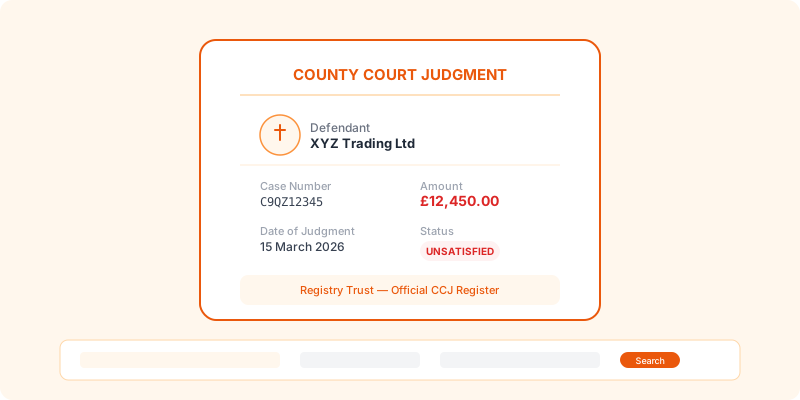
- Results show the court, case number, date, amount, and whether the judgment was satisfied
- Searches are by exact name, so try variations if the first search returns nothing
Business Credit Reference Agencies
Experian, Equifax, and TransUnion all include CCJ data in their business credit reports. These aggregate CCJ data alongside payment behaviour and Companies House filing history - more convenient for regular due diligence work than individual Registry Trust searches.
What Do CCJs Tell You?
A CCJ reveals more than just unpaid debt. Here is how to interpret what you find:
- Single small CCJ: Could be a one-off dispute. Check if it is satisfied - it may reflect a genuine disagreement rather than an inability to pay
- Multiple CCJs: A pattern of CCJs is a serious red flag suggesting systematic non-payment of debts
- Large CCJ amounts: A CCJ for tens of thousands of pounds against a small company can indicate cashflow problems severe enough to threaten viability
- Recent CCJs: More concerning than older ones. A CCJ from last month carries far more weight than one from five years ago
- Unsatisfied CCJs: The company still has not paid even after a court order - the strongest negative signal of all
CCJs and Business Credit Scores
CCJs have a significant impact on business credit scores. A single unsatisfied CCJ can:
- Cause a major drop in a company's credit rating
- Make it nearly impossible to obtain trade credit from suppliers
- Prevent the company from getting business loans or credit cards
- Deter potential customers, partners, and investors
Even a satisfied CCJ continues to affect the score for the full 6-year period it remains on the register.
Using CCJ Data for Due Diligence
Whether you are a supplier extending credit, an investor evaluating a target, or a business considering a new partnership, CCJ checks should be part of your standard due diligence:
- Check the company name on Registry Trust or via a credit agency
- Check director names individually - directors with personal CCJs are also a risk signal
- Cross-reference with Companies House filings for broader context (accounts overdue? confirmation statement late?)
- Look at the trend - is the CCJ situation getting better or worse over time?
How NewcoHunter Helps
When you discover new companies through NewcoHunter's monitoring service, CCJ checks are a natural next step before making contact. NewcoHunter identifies newly incorporated companies by SIC code and location, giving you the earliest possible window to research and qualify leads - including checking their directors' CCJ history before investing time in outreach.
Use NewcoHunter to find fresh UK company registrations, then run CCJ checks on your most promising leads as part of the qualification process.
Frequently Asked Questions
Is a CCJ check free in the UK?
The official Registry Trust search costs £2 per name. Free options include checking Companies House filing history for winding-up petitions and administration orders, or using a credit agency's free report tier. A completely free CCJ check will not give you the full official register result - for that, the £2 Registry Trust search is the lowest-cost authoritative option.
How do I check if a company has a CCJ?
Search the company name on the Registry Trust website (trust.co.uk) for £2. Alternatively, use a business credit agency such as Experian, Equifax, or CreditSafe which include CCJ data in their reports. For a quick free indicator, check the company's filing history on Companies House for any winding-up petitions or administration orders.
What is the difference between a CCJ and a decree?
In England and Wales, court debt judgments are called County Court Judgments (CCJs). In Scotland, the equivalent is a Decree. Northern Ireland has its own separate court system. The terms "County Court Judgments" and "County Court Judgements" both refer to the same thing - both spellings are widely used across the UK.
How long does a CCJ stay on a company's record?
CCJs remain on the Register of Judgments, Orders and Fines for 6 years from the judgment date. If the full amount is paid within 1 month of judgment, the CCJ is removed from the register entirely. If paid after 1 month, the CCJ stays on record but is marked "satisfied" - which is better than unsatisfied, but still visible to creditors and partners.
Can I check a director's personal CCJ history?
Yes. Registry Trust searches work for individual names as well as company names. For thorough due diligence, run searches for both the company and its key directors. A director with multiple personal CCJs is a significant risk signal, even if the company itself currently has a clean record.
Summary
- CCJs (County Court Judgments or Judgements) are court-ordered debt records kept for 6 years
- Free options: Companies House filing history, credit agency free tiers, court records at gov.uk
- Paid: Registry Trust at £2 per search (official register) or business credit agency reports
- Multiple or unsatisfied CCJs are serious red flags
- Always check both the company and its directors
- CCJ checks should be standard in any B2B due diligence process
Using NewcoHunter to Check Company Risk Signals
County court judgments are one indicator of financial stress - but there are earlier signals visible from Companies House data that can flag a risky counterparty before things get to court.
- Overdue accounts - a company that is consistently late filing its annual accounts is often in financial difficulty. See UK companies with overdue accounts at Companies House.
- Negative net assets - when a company's total liabilities exceed its total assets, it is technically balance-sheet insolvent. See UK companies with negative net assets.
- Proposal to strike off - Companies House issues this notice when a company has failed to file required documents. It often precedes insolvency. See companies currently facing strike-off.
- In administration or liquidation - formal insolvency proceedings. Companies in administration and companies in liquidation.
You can also verify any UK company's current status, directors, SIC codes, and filing history using the free Companies House search tool. For due diligence on company ownership, the PSC (Persons with Significant Control) lookup shows who ultimately owns and controls a company.
Related Guides
About the author
Alexis Pratsides is founder of NewcoHunter. The product reads the UK company register every day. More about Alexis
Related Articles
UK Companies in Administration - How to Spot the Warning Signs Before It Happens
Companies already in administration are too late to sell to. But the warning signs appear weeks or months before a formal appointment. Here is how to read them from Companies House data.
New Companies Registered in London - Latest Incorporations
London registers more new companies than any other part of the UK - roughly four in ten new incorporations happen here. Here is what the data shows, which sectors are driving it, and how B2B teams can turn the volume into a prospecting advantage.
New Companies Registered in Manchester - Latest Incorporations
Manchester has become the UK's most active business hub outside London, with the North West consistently registering more new companies each year than any other English region beyond the capital. Here is the data, which sectors are growing fastest, and how to prospect effectively.
Explore more
Ready to find your next client?
Get instant access to new UK company registrations, filtered by industry and location.
Get started free