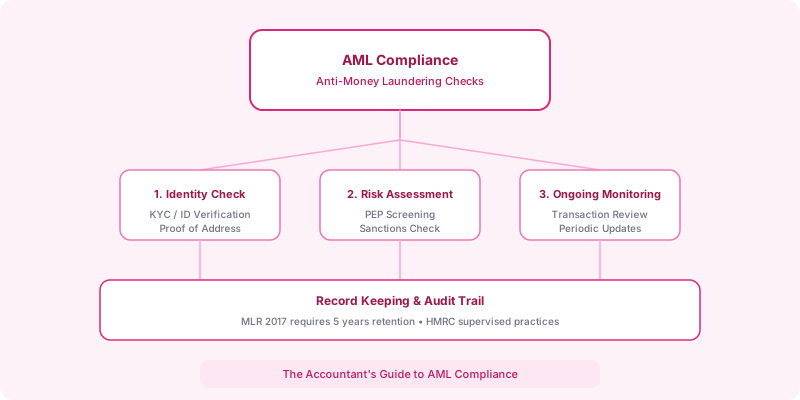
AML Checks for Accountants: A Practical Compliance Guide
Accountants in the UK are legally required to conduct anti-money laundering (AML) checks on all clients. Under the Money Laundering, Terrorist Financing and Transfer of Funds Regulations 2017 (MLR 2017), accounting practices must identify clients, assess risk, and maintain records - or face penalties from their supervisory body and potentially criminal prosecution.
Who Supervises Accountants for AML?
AML supervision for accountants is handled by professional bodies, not HMRC (unless the practice isn't a member of a professional body). The main supervisors are:
- ICAEW - Institute of Chartered Accountants in England & Wales
- ACCA - Association of Chartered Certified Accountants
- ICAS - Institute of Chartered Accountants of Scotland
- AAT - Association of Accounting Technicians
- HMRC - For practices not supervised by a professional body
Each supervisor can inspect your AML procedures, demand to see your risk assessments and CDD records, and impose fines or sanctions for non-compliance.
The Three Pillars of AML Compliance
1. Customer Due Diligence (CDD)
Before taking on any client, you must:
- Identify the client: Verify their identity using reliable, independent sources. For individuals, this typically means passport/driving licence plus a proof of address. For companies, it means checking Companies House records
- Identify beneficial owners: For companies and trusts, identify anyone who owns or controls more than 25% of the entity
- Understand the business relationship: Know what services the client needs and why
CDD must be completed before you begin providing services. You cannot defer it - if you can't complete CDD, you must not act for the client.
2. Risk Assessment
You need both a practice-wide risk assessment and individual client risk assessments:
Practice-Wide Risk Assessment
Document the ML/TF risks your practice faces based on:
- Types of services you offer (audit, tax, bookkeeping, company formation)
- Types of clients (individuals, SMEs, trusts, overseas entities)
- Geographic exposure (high-risk countries)
- Delivery channels (face-to-face vs. remote)
Client Risk Assessment
For each client, assess the risk based on:
- Client type: PEPs, complex structures, and non-resident clients are higher risk
- Country risk: Clients connected to countries on FATF's grey or black lists
- Service risk: Company formation and trust work are inherently higher risk than basic bookkeeping
- Transaction patterns: Unusual payment patterns, cash-intensive businesses
3. Ongoing Monitoring
AML compliance doesn't end at onboarding. You must:
- Keep CDD information up to date - re-verify at least when the engagement is renewed
- Monitor transactions and activities for anything inconsistent with your understanding of the client
- Screen against sanctions lists (OFSI consolidated list)
- File Suspicious Activity Reports (SARs) with the NCA when you identify concerns
Enhanced Due Diligence (EDD)
Higher-risk situations require enhanced measures. You must apply EDD when:
- The client is a PEP (Politically Exposed Person) or a family member/close associate of a PEP
- The client is from a high-risk third country identified by the EU or FATF
- The transaction is unusually complex or has no apparent economic purpose
- There are other factors that increase ML/TF risk
EDD might include obtaining additional identification documents, understanding the source of funds, obtaining senior management approval, and conducting enhanced ongoing monitoring.
Record Keeping
You must retain AML records for 5 years after the business relationship ends. This includes:
- Copies of identification documents (or references to them)
- Client risk assessments
- Records of CDD and EDD measures applied
- Transaction records
- Internal SAR considerations (even if not reported to NCA)
Practical Tips for Efficient AML
- Standardise your onboarding form: Create a template that captures all required CDD information in one go
- Use electronic verification: Services like Creditsafe, SmartSearch, or Thirdfort can automate ID verification and PEP/sanctions screening
- Check Companies House for company clients: Verify the company exists, check the PSC register, and confirm director details match what the client has told you
- Document your reasoning: If you decide a client is low-risk, write down why. Supervisors want to see your thought process
- Train your team: All relevant staff must receive AML training, and you must be able to prove it
How NewcoHunter Supports AML
When onboarding a new company client, NewcoHunter's data can help verify key company details from Companies House - incorporation date, SIC code, registered address, and directors. For accountants who actively prospect for new clients, our new company monitoring service identifies freshly incorporated businesses in your target sectors, giving you the earliest opportunity to begin a compliant onboarding process.
Key Dates and Penalties
- MLR 2017 came into force on 26 June 2017, with amendments in 2019, 2020, and 2022
- Penalties range from public censure to unlimited fines and criminal prosecution
- In 2024, HMRC issued over £4 million in AML penalties to accountancy businesses
- Failure to register with a supervisor is itself a criminal offence
About the author
Alexis Pratsides is founder of NewcoHunter. The product reads the UK company register every day. More about Alexis
Related Articles
UK Companies in Administration - How to Spot the Warning Signs Before It Happens
Companies already in administration are too late to sell to. But the warning signs appear weeks or months before a formal appointment. Here is how to read them from Companies House data.
New Companies Registered in London - Latest Incorporations
London registers more new companies than any other part of the UK - roughly four in ten new incorporations happen here. Here is what the data shows, which sectors are driving it, and how B2B teams can turn the volume into a prospecting advantage.
New Companies Registered in Manchester - Latest Incorporations
Manchester has become the UK's most active business hub outside London, with the North West consistently registering more new companies each year than any other English region beyond the capital. Here is the data, which sectors are growing fastest, and how to prospect effectively.
Explore more
Ready to find your next client?
Get instant access to new UK company registrations, filtered by industry and location.
Get started free